On North Park Street in the Village of Cambridge is a cemetery known by two names. Washington County assessment records call it North Park Street Cemetery. A 1976 commemorative marker identifies it as Old White Church Cemetery.
The second name preserves the memory of a Presbyterian meetinghouse erected in 1832 and known during the nineteenth century as the White Church.
The cemetery belongs to the history of both Cambridge and White Creek. It lies within the incorporated Village of Cambridge and, for town and assessment purposes, within the Town of White Creek.
Its surviving records connect religious history, municipal geography, burial practice, family history, military commemoration, and community memory.
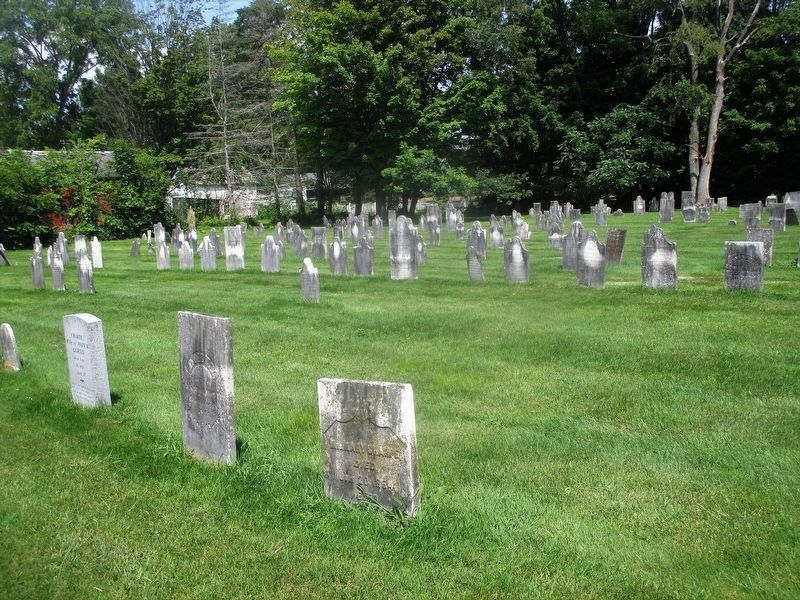
General view of Old White Church Cemetery. Mira Earls, August 10, 2021. From the approved historical article; original source: Historical Marker Database.
Historical evidence can help explain how the cemetery developed. It does not replace the deed research needed to determine present legal title.
The congregation and the White Church
A congregation rooted in the Cambridge Valley
The congregation associated with the Old White Church traces its organized history to August 1793. The historical sources agree on the month and year but differ on the exact day.
That agreement provides a starting point for the story. The precise organization date remains a question for the original church and incorporation records.
The building remembered as the White Church
A second meetinghouse was erected in 1832. Allen Corey’s account, written less than twenty years later, records that it was known as the White Church. The name was in use during the nineteenth century, rather than being a later label applied to the building.
A later church building followed in 1872. The cemetery’s surviving name preserves the memory of the 1832 meetinghouse.
A public burying ground
The church and the cemetery were related, but not identical
Corey’s nineteenth-century account makes an important distinction between the congregation’s property and the burial ground.
“The Burying Ground was given as a public Burying Ground, and does not belong to the Congregation.”
Allen Corey, Gazetteer of the County of Washington, N.Y., 1849-1850
The statement identifies the burying ground as public and distinguishes it from congregational property. It does not identify the original donor, grantee, boundaries, terms of conveyance, later chain of title, or present legal ownership.
A cemetery serving a wider community
Corey’s account helps explain why the cemetery should be understood as more than an appendage of a single church. The burial ground has a place in the wider history of the Cambridge Valley.
Gravestones can be read alongside church records, family history, probate records, military records, deeds, and municipal records. Together, those sources offer ways to understand the people commemorated here and their connections across the surrounding community.
Primary source
Bicentennial Dedication: July 4, 1976
A contemporary newspaper clipping has added an important primary source to the history of Old White Church Cemetery.
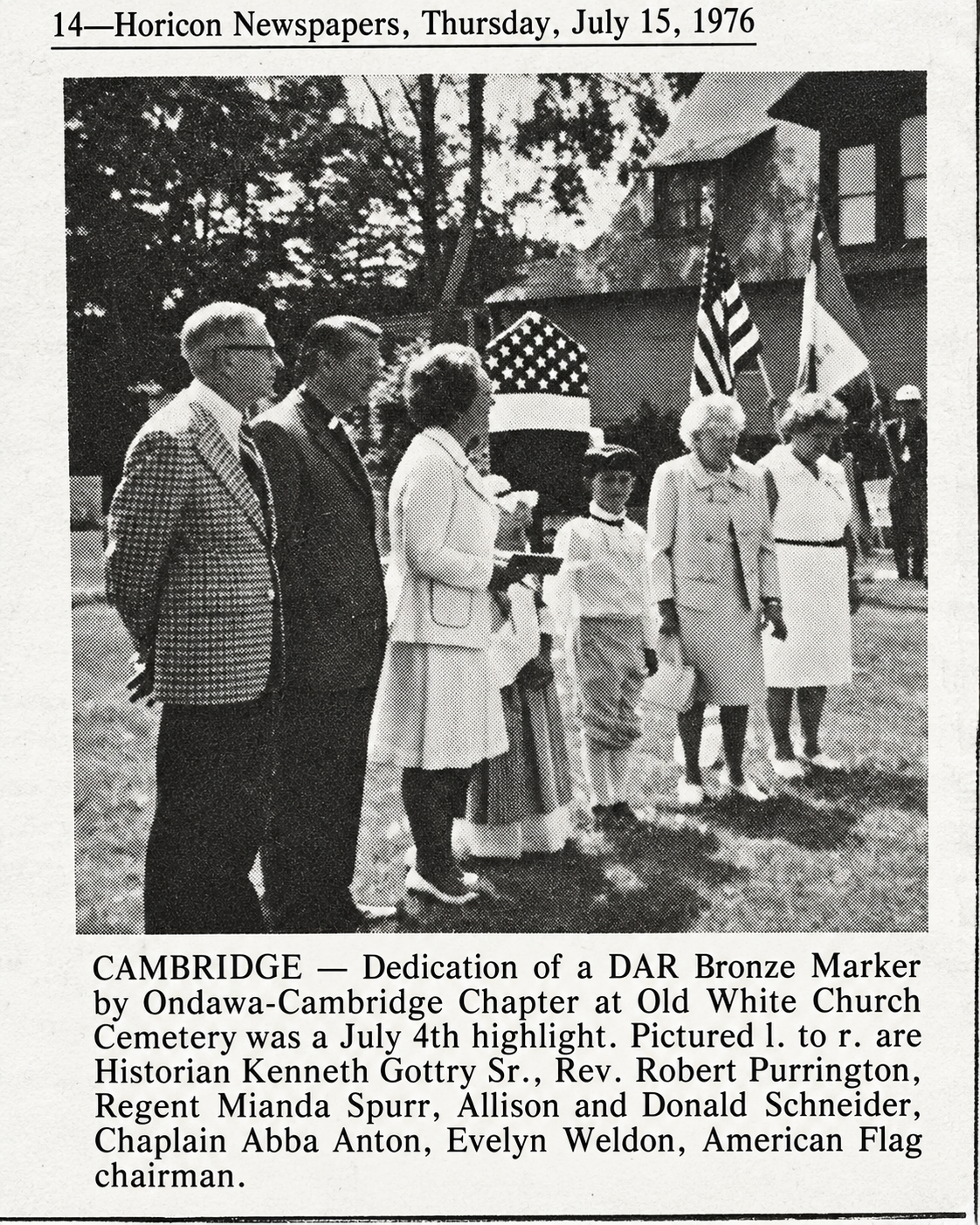
Published on July 15, 1976, the clipping records the Ondawa-Cambridge Chapter DAR dedication of a bronze marker at the cemetery as a July 4 Bicentennial highlight.
The photograph caption identifies Historian Kenneth Gottry Sr., Rev. Robert Purrington, Regent Mianda Spurr, Allison and Donald Schneider, Chaplain Abba Anton, and Evelyn Weldon, American Flag chairman.
A Fifty-Year Connection
The clipping was supplied in 2026 by local historian Ken Gottry. His father, Kenneth Gottry Sr., is identified in the 1976 newspaper caption as the historian participating in the dedication. Ken recalls that his father gave the dedication speech.
Fifty years later, Ken Gottry raised the practical question that began the current inquiry: who owns or cares for the Old White Church Cemetery?
The connection illustrates how local history survives through many kinds of evidence, including official records, newspapers, commemorative markers, family collections, and community memory.
Washington County Post, Thursday, July 15, 1976, p. 14. Contemporary account of the July 4 dedication of a DAR bronze marker at Old White Church Cemetery. Clipping supplied by Ken Gottry.Open the clipping at full size ↗
Source record
Washington County Post, Thursday, July 15, 1976, p. 14. Contemporary newspaper clipping documenting the July 4 dedication of the DAR bronze marker at Old White Church Cemetery. Clipping supplied by Ken Gottry in 2026.
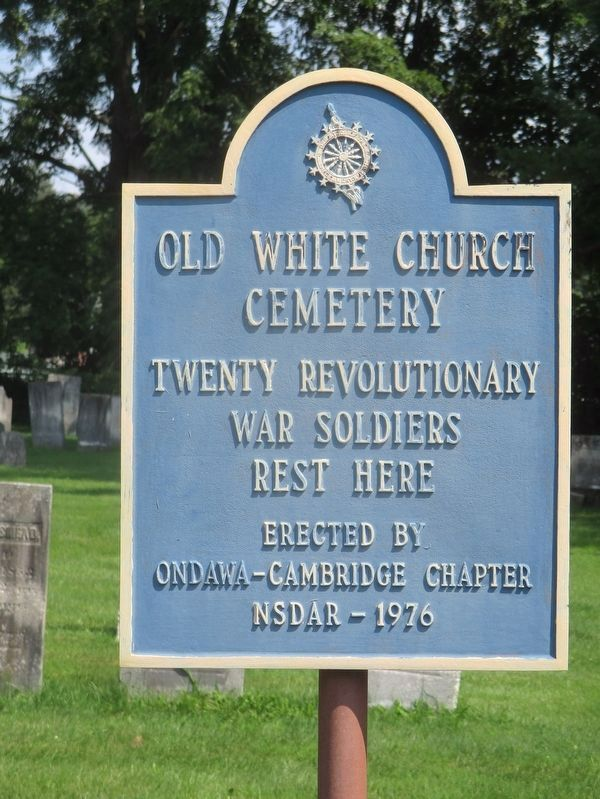
The 1976 DAR marker. Mira Earls, August 10, 2021. From the approved historical article; original source: Historical Marker Database.
Revolutionary War commemoration
Twenty Revolutionary War soldiers
A 1976 marker erected by the Daughters of the American Revolution (DAR) commemorates the cemetery as the resting place of twenty Revolutionary War soldiers.
The marker itself, its inscription, and its July 4, 1976 dedication are now documented by both the surviving marker and a contemporary newspaper account.
The marker states that twenty Revolutionary War soldiers rest in the cemetery. The 1976 newspaper clipping confirms the dedication of the marker, but it does not independently establish the underlying veteran-by-veteran burial count. That remains a separate historical research question.
The cemetery and its community
The cemetery in current records
Washington County identifies North Park Street Cemetery as Tax Map Parcel 256.17-1-26. The assessment classification places it under the Village of Cambridge, including exemption code 13660 for a village-owned cemetery for assessment purposes.
This assessment classification is not a title examination.
How did the public burying ground described by Corey come to occupy its present place in municipal records?
The documentary path between those points has not yet been fully reconstructed.
Why this place matters
The cemetery brings together religious history, public burial practice, local families, and military commemoration. It also connects Cambridge and White Creek municipal geography, reported maintenance history, unresolved title history, and community memory.
A cemetery can carry the name of a church without necessarily having been owned by that church. Maintenance, ownership, municipal jurisdiction, public use, and community identity can follow different historical paths.
What we know and what remains open
Supported by the present historical record
Congregation organized in August 1793
1832 meetinghouse
Historical use of the name White Church
Corey’s public-burying-ground statement
Later 1872 church building
A contemporary newspaper clipping dated July 15, 1976 documents the July 4 Bicentennial dedication of the Ondawa-Cambridge Chapter DAR bronze marker at Old White Church Cemetery.
Kenneth Gottry Sr. is identified in the contemporary caption as Historian and as a participant in the dedication.
1976 DAR marker
Parcel 256.17-1-26
Current assessment classification
Still being researched
Exact day of organization in August 1793
Original cemetery conveyance or dedication
Donor, grantee, boundaries, and terms of the public burying-ground gift or dedication
Complete title history
Development of municipal ownership, control, or maintenance responsibility
Relationship between assessment classification and recorded title
Veteran-by-veteran basis for the DAR marker’s twenty-person claim
Historical resources
Best for: A concise introduction
The Old White Church Cemetery: A Brief Historical Guide
A concise illustrated introduction to the cemetery, the White Church, nineteenth-century evidence, timeline, DAR marker, and current research questions.
The Old White Church and North Park Street Cemetery
A longer source-based study of the congregation, White Church, burial ground, community history, historical evidence, photographs, research gaps, and selected notes.